
Health and Safety Policy for Flat Clearance London
Purpose: This policy sets out the commitment of our flat clearance and apartment clearance teams to protect the health, safety and welfare of everyone affected by our operations. It applies to all residential and commercial flat removal activities, including flat clearance London assignments, and covers staff, contractors and members of the public who may be impacted by our work. We adopt a proactive approach to risk management and emphasise safe systems of work that prioritise wellbeing and environmental responsibility.Scope: The policy embraces every aspect of the clearance process: from initial site assessment and collection of bulky items to transport, sorting and disposal. Our London flat clearance services are delivered with consistent procedures regardless of property size: apartment clearance, studio clearance, multi-room removals and communal area clear-outs are all governed by the same standards. The following sections outline responsibilities, key controls and continuous improvement measures designed to maintain safe working conditions.

Responsibilities and Organisation
Management is accountable for establishing and maintaining a safe operating environment. Supervisors and team leaders must ensure that employees follow the procedures for safe handling, lifting and transportation of goods. All operatives involved in flat clearance services in London must receive appropriate instruction and must report any hazards or unsafe practices immediately. Individual responsibilities include:- Reporting hazards and near misses
- Using appropriate personal protective equipment and tools
- Following safe lifting and vehicle loading techniques
Risk Assessment and Hazard Control
We conduct physical risk assessments prior to every clearance project. Typical hazards addressed include manual handling risks, sharp or broken items, hazardous household waste, trip and fall hazards, and site-specific issues such as limited access or steep stairways. Risk controls include method statements, controlled access to work zones, safe stacking procedures and use of mechanical aids. Our approach to risk follows the hierarchy of controls: eliminate, substitute, engineer controls, administrative controls and personal protective equipment.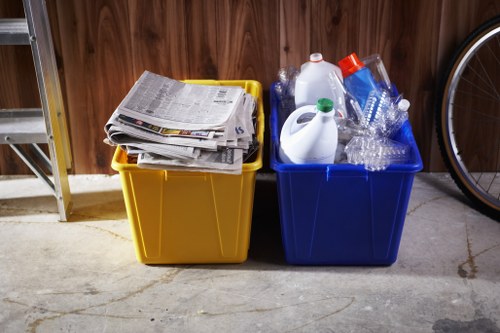
Training, Personal Protective Equipment and Safe Work Practices
Employees receive training in manual handling, moving and lifting techniques, correct use of trolleys and dollies, and use of protective gloves, eye protection and high-visibility clothing where appropriate. New staff and contractors are inducted to our safety standards, and refresher training is scheduled regularly. We emphasise communication on site, pair-lifting for heavy items, and safe loading patterns for vans and removal vehicles. The use of adequate PPE and equipment maintenance are mandatory to prevent accidents and reduce long-term strain injuries associated with repetitive tasks.Waste Handling and Environmental Controls All cleared materials are handled with due regard for environmental protection and public safety. We segregate waste streams at source where practicable and prioritise donation, reuse and recycling over disposal. Hazardous household substances are identified and separated for specialist disposal. Our teams follow clear procedures for secure storage of materials awaiting transfer, minimizing both contamination risks and potential injury to handlers. For larger clearances we coordinate safe transfer routes to avoid obstructions and ensure safe vehicle access.
Equipment, Vehicles and Site Safety
All tools, lifting aids and vehicles are subject to regular inspection and maintenance to ensure fitness for purpose. Equipment faults are reported immediately and taken out of service until repaired. Vehicle loading is planned to maintain stability and visibility, and drivers adhere to safe driving standards when transporting items between sites. Our flat clearance services include safe use protocols for ramps, tail lifts and securing methods to prevent shifting during transit.
Emergency Response, Incident Reporting and First Aid
We maintain clear emergency procedures tailored to each site. Staff are trained in basic first aid and incident reporting. Any accident, near miss or unsafe condition is documented and investigated to identify root causes and corrective actions. Timely reporting and follow-up drive learning and help prevent recurrence. The organisation supports affected employees and makes reasonable adjustments during recovery and return-to-work planning. Monitoring, Review and Continuous Improvement
We regularly audit operations, review risk assessments and update processes to reflect lessons learned and changing working conditions. Performance indicators such as incident rates, training completion and audit results are used to monitor compliance and drive improvements. This Health and Safety Policy is reviewed at defined intervals and after significant events to ensure it remains effective and relevant to the nature of our flat clearance activities. Commitment: We are committed to maintaining high safety standards across all flat and apartment clearance projects, ensuring every task is planned and carried out with safety and respect for people and the environment.
Monitoring, Review and Continuous Improvement
We regularly audit operations, review risk assessments and update processes to reflect lessons learned and changing working conditions. Performance indicators such as incident rates, training completion and audit results are used to monitor compliance and drive improvements. This Health and Safety Policy is reviewed at defined intervals and after significant events to ensure it remains effective and relevant to the nature of our flat clearance activities. Commitment: We are committed to maintaining high safety standards across all flat and apartment clearance projects, ensuring every task is planned and carried out with safety and respect for people and the environment.
Implementation: This policy is brought to life through visible leadership, worker involvement and a culture that encourages reporting, learning and innovation. By integrating safe working practices into every aspect of our flat clearance operations, we aim to deliver reliable, responsible and risk-aware services across London and surrounding areas.